

Don't Switch On CEP at Launch: When the Central Europe Programme Actually Pays
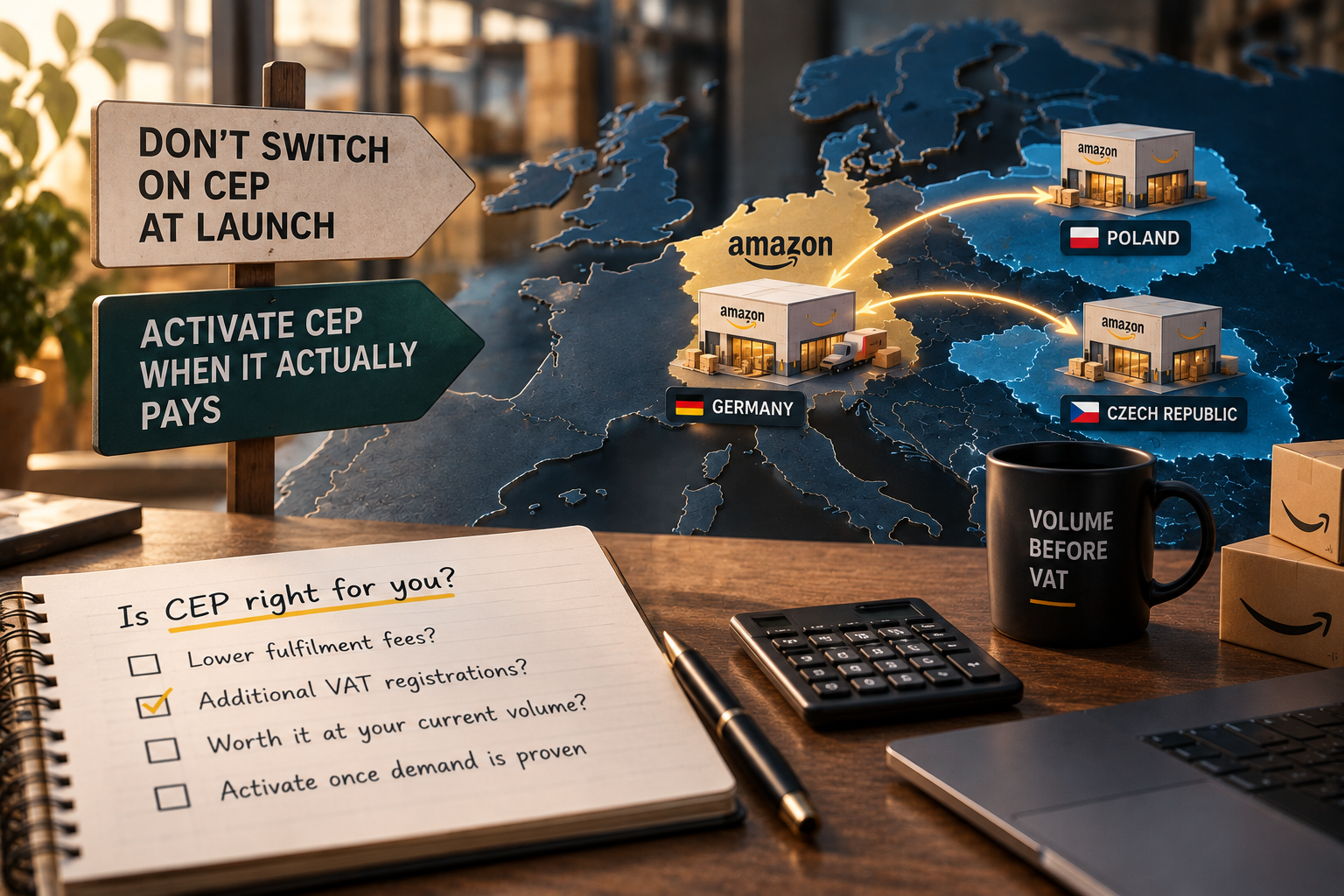
If you sell in Germany, Amazon will happily encourage you to switch on the Central Europe Programme — CEP — which lets it store and fulfil your stock from neighbouring lower-cost countries (Poland and the Czech Republic) as well as Germany, reducing your fulfilment fees. Cheaper fulfilment sounds like an obvious yes. But switching it on at launch is usually a mistake, because the fee saving comes bundled with a cost most sellers don't factor in: additional VAT-registration overhead. Let me explain when CEP actually pays and when it just adds admin for a saving you're too small to benefit from.
What CEP does — and the hidden cost
CEP's pitch is straightforward: allow Amazon to place your German-market stock in Poland and the Czech Republic too, and it'll fulfil from wherever's cheapest, passing you lower per-unit fulfilment fees. For a high-volume seller, those per-unit savings add up to real money.
But here's the catch that the "cheaper fulfilment!" framing skips over: storing your stock in Poland and the Czech Republic means holding inventory in those countries — and holding stock in a country generally triggers a VAT-registration obligation there. So enabling CEP typically means taking on VAT registration (and the ongoing returns and compliance) in additional countries. The fulfilment fee goes down; the VAT admin and cost go up. CEP isn't a free saving — it's a trade of VAT overhead for lower per-unit fulfilment cost.
Why that trade is bad at launch
Now do the maths of that trade at launch, when your volume is low. The fulfilment-fee saving is per unit — so its total value depends entirely on how many units you're shipping. At launch, you're shipping few units, so the total saving is small. Meanwhile the VAT overhead is a fixed cost — the registrations and returns cost roughly the same whether you're shipping ten units or ten thousand.
So at low volume you get a tiny per-unit saving against a fixed overhead — which means the overhead swamps the saving. You'd be taking on VAT registration in extra countries to save a trivial amount on a small number of units. The trade only makes sense when the per-unit saving, multiplied by your volume, comfortably exceeds the fixed VAT overhead — and that requires volume you don't have at launch. Switching CEP on early is paying a fixed cost to unlock a saving too small to cover it.
This is a specific instance of a general discipline: a fixed cost is only worth taking on when your volume is large enough to spread it thin. At launch your volume can't spread it, so the fixed cost dominates. Wait until the volume is there, and the same fixed cost becomes trivial per unit.
When CEP actually pays
So the rule is simple: don't switch on CEP at launch — activate it once your volume justifies the fixed cost. The per-unit fulfilment saving is real and worth having, but only once you're shipping enough units that the total saving clearly outweighs the added VAT overhead of holding stock in the extra countries.
Practically, that means treating CEP as a later optimisation, not a launch setting. Get established in your core market first. Prove the volume. Then, when you're shipping enough that the fulfilment savings are material, run the numbers: does the annual per-unit saving at your current volume comfortably exceed the annual cost of the additional VAT registrations and compliance? When the answer is a clear yes, switch it on. Until then, leave it off and keep your compliance footprint lighter.
The broader lesson about Amazon's nudges
There's a wider point here worth internalising, because CEP is one example of a pattern. Amazon will nudge you toward programmes that benefit it (more of your stock in its network, more efficient fulfilment across its warehouses) framed as benefits to you (lower fees!). Sometimes those genuinely align with your interests; sometimes, especially early, they don't — because the framing shows you the saving and quietly omits the overhead that comes with it.
So treat every "switch this on to save money" nudge the way you'd treat CEP: ask what it costs you, not just what it saves you. What does enabling this actually commit me to — VAT registrations, fixed overheads, compliance obligations? And is my volume high enough that the saving outweighs those costs yet? Often at launch the honest answer is "not yet," and the disciplined move is to decline the nudge until the maths turns in your favour. Cheaper fulfilment that comes bundled with VAT registration in two more countries isn't cheaper at all when you're only shipping a handful of units. Wait until it is.
*General orientation, not legal or tax advice — programme rules and VAT requirements change; confirm current details and take professional advice before acting.
FAQ
What is Amazon's Central Europe Programme (CEP)?
It lets Amazon store your German FBA inventory in Poland and the Czech Republic as well as Germany, reducing fulfilment fees. In exchange, holding stock in those countries generally triggers a VAT registration obligation there.
Why is it usually a mistake to switch on CEP at launch?
Because the fulfilment fee saving is per unit, so it's small when your shipping volume is low, while the VAT registration and compliance cost is largely fixed. At launch, the fixed overhead swamps the small saving.
When does CEP actually pay off?
Once your shipping volume is high enough that the total per-unit fulfilment saving clearly and comfortably exceeds the annual cost of the additional VAT registrations and compliance in Poland and the Czech Republic.
About the author
Zamir Cajee is co-founder of This Way Up, a UK business specialising in Amazon marketplace strategy, and co-host of The Upside Podcast, where he and the team break down how Amazon actually works and how it lies to you. Zamir has built multi-million dollar businesses from scratch and has been selling into the EU since 2016.
Not sure if your volume justifies switching on CEP yet? Reach out to us for tailored guidance.
Subscribe to the This Way Up newsletter for impactful strategies and insights, or tune in to The Upside podcast for expert advice on successfully managing your e-commerce efforts.