

Once you've diagnosed where your problem actually is, there's one more discipline that stands between you and a wasted budget: making sure the remedy you reach for can actually operate at the stage where the problem lives. It sounds obvious. It's violated constantly, and every violation costs money — because a lever applied at the wrong stage doesn't just fail to help, it burns spend while the real problem carries on untouched.
Every lever has a scope — and only one
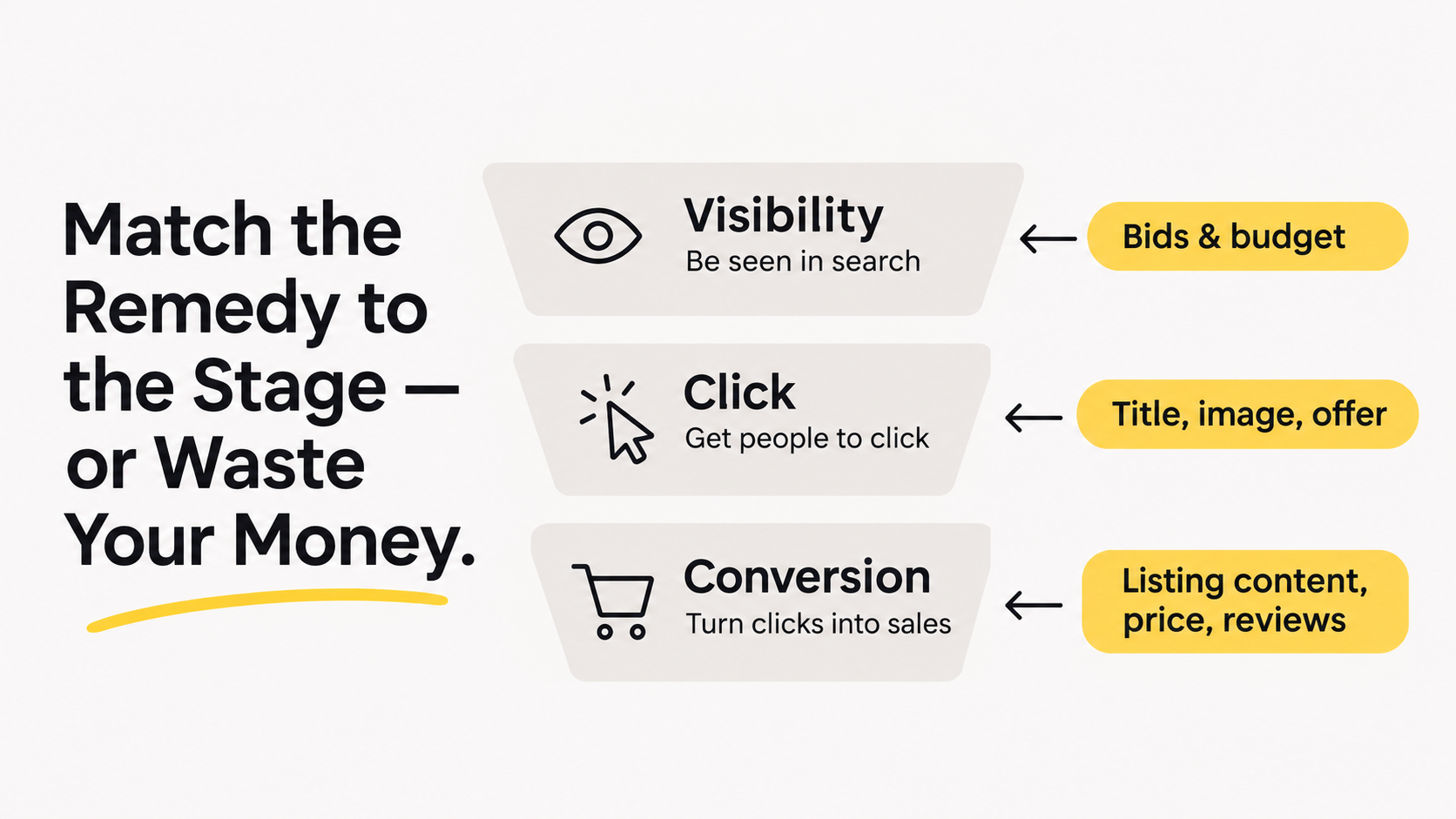
The key idea is that each tool or action on Amazon has a scope — a specific thing it acts on — and it is powerless outside that scope. Get clear on these and a whole category of expensive mistakes disappears:
Bid and budget levers act on visibility, not conversion. Raising a bid or a budget gets you shown more — more impressions, more presence. That's it. It has no power over whether someone clicks you once shown, or buys once they click. So a bid or budget change can address a visibility problem and can do absolutely nothing for a conversion problem. If people are seeing you and not buying, spending more to show them to more people changes nothing about the reason they're not buying.
An automated bidder adjusts bids only. It hunts for a price within the ceiling you set. It has no conversion lever whatsoever — it cannot make your listing more persuasive, cannot improve your images, cannot fix your price-value story. So the answer to "why isn't my listing converting?" is never the auto-bidder, and a conversion outcome should never be credited or blamed on it. It simply doesn't operate there.
Listing-content levers act on attraction and persuasion, not on being shown. Your images, title, bullets, product-page content — these affect whether people click you and whether they buy once they've clicked. They do not affect whether Amazon shows you in the first place. So rewriting your product page does nothing for a visibility problem where the issue is that nobody's seeing the page at all.
Each lever, in other words, has exactly one stage where it works. Match it to that stage and it's powerful. Aim it anywhere else and it's money on fire.
The category error that burns budgets
When you cross these wires — apply a lever outside its scope — you commit what is essentially a category error, and it's one of the most common ways Amazon money gets wasted. A few of the classic ones:
Prescribing more ad spend for a conversion problem. The single most common and most expensive version. Your listing converts poorly, so you... buy more traffic to it. You've now paid to send more people to a page that doesn't convince them. You haven't fixed the conversion problem; you've scaled it. The more you spend, the more it costs you, because advertising has no conversion lever — it can only bring more people to the same unpersuasive page.
Treating a click-share problem with product-page edits. People are seeing you and not clicking — the problem is at the search results, in how you appear. So you go and rewrite your product-page content, which they never reach because they're not clicking. You've polished a room nobody's entering.
Treating a conversion problem with a bid change. People click and don't buy — a persuasion problem on the page. So you adjust your bids, which changes how often you're shown, which does nothing about the reason clickers aren't buying.
Every one of these is a confident action aimed at the wrong stage. The lever works fine — it's just pointed at a problem it has no power over.
The habit that prevents it
The prevention is a single question, asked before you reach for any lever: does this lever actually operate at the stage where I've located my problem? You've diagnosed the problem to a stage — visibility, the click, the purchase, the economics. Now, before you act, check that the tool you're about to use has a lever at that stage. If your problem is conversion and you're reaching for a bid change, stop — wrong scope. If your problem is visibility and you're rewriting your product page, stop — wrong scope.
This is the natural partner to diagnosing before you fix. Diagnosis tells you where the problem is; the scope check tells you whether your intended remedy can reach it. Do both, and every pound and every hour you spend lands on a lever that can actually move the thing you're trying to move. Skip the scope check, and you'll spend confidently and repeatedly on remedies that were never capable of fixing your problem — busy, expensive, and aimed at the wrong stage the whole time.
Match the remedy to the stage. It's the difference between spending to fix your problem and spending to feel like you're doing something about it.
FAQ
Why can’t a bid or budget increase fix a conversion problem?
Bid and budget levers act on visibility only, meaning how often you are shown. They have no power over whether someone clicks once shown or buys once they click, so spending more just sends more people to the same unpersuasive page.
Can an automated bidder improve my listing’s conversion?
No. An automated bidder only adjusts bids within the ceiling you set. It cannot make your listing more persuasive, improve your images or fix your price-value story, so a conversion outcome should never be credited or blamed on it.
How do I avoid applying the wrong remedy?
Diagnose where the problem sits first, then ask before acting whether the lever you are about to use actually operates at that stage. If the problem is conversion, a bid change is the wrong scope, and if it is visibility, rewriting your product page is.
About the author
Zamir Cajee is co-founder of This Way Up, a UK business specialising in Amazon marketplace strategy, and co-host of The Upside Podcast, where he and the team break down how Amazon actually works and how it lies to you. Zamir has built multi-million dollar businesses from scratch and has been selling into the EU since 2016.
Not sure whether your problem is visibility, clicks or conversion? Let us diagnose it before you spend. Reach out to us for tailored guidance.
Subscribe to the This Way Up newsletter for impactful strategies and insights, or tune in to The Upside podcast for expert advice on successfully managing your e-commerce efforts.