

Almost all the energy in Amazon strategy goes into acquisition — winning the customer at the search results, out-bidding and out-converting rivals for the click. Fair enough; you have to win customers. But there's a whole side of the board most brands barely touch, and it's the one that quietly makes acquisition easier: retention. Because a customer you've genuinely retained has been lifted off the battlefield entirely — and a subscribed customer simply can't be stolen at the search results.
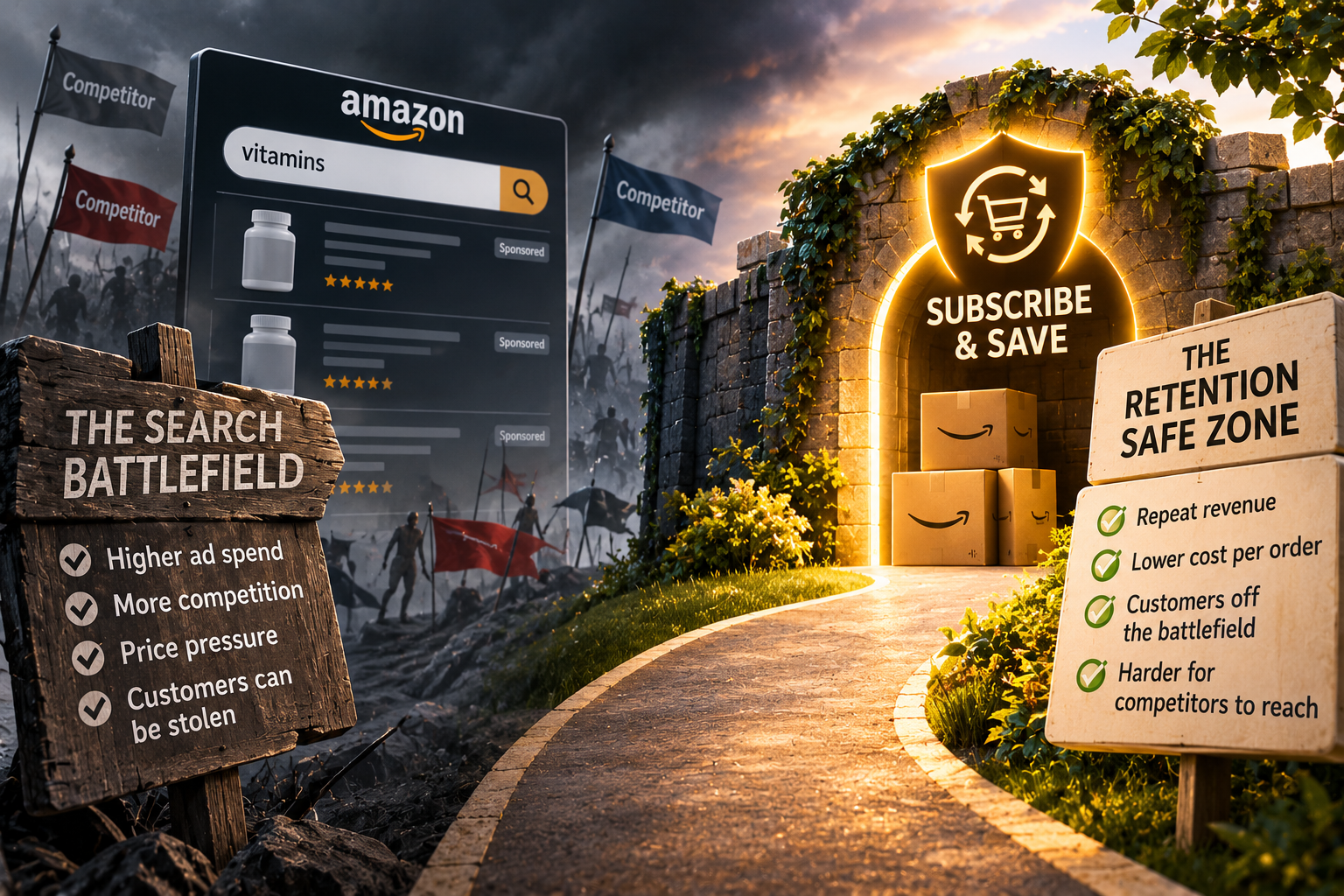
The battlefield you're fighting on
Think about where all the competition actually happens. It happens at the search results page — that's where customers compare options, where competitors conquest your terms, where your brand gets served alongside rivals, where the whole expensive fight for attention takes place. Every acquisition pound you spend is spent there, on that contested ground, competing for a customer who's actively looking and actively being marketed to by everyone else.
Now here's the thing about a customer on Subscribe & Save, or one who's genuinely locked into buying your product on repeat because it earned their loyalty: they don't go to the battlefield any more. They're not searching your category. They're not comparing options. They're on autopilot — the product arrives, or they reorder directly, without ever passing through the contested search results where a competitor could intercept them. You cannot conquest, at the search results, a customer who no longer visits the search results. They've left the arena. They're safe.
That's what retention really does, strategically. It's not just "nice recurring revenue." It's the act of taking a customer out of the contested space and putting them somewhere no competitor's advertising can reach. Every subscribed or genuinely-loyal customer is a chunk of revenue that's become structurally defendable, because it's no longer exposed to the fight.
Why this is the most underused defence there is
Most brands spend fortunes acquiring customers and almost nothing retaining them. They win the customer at great expense on the battlefield — and then just… let them wander back onto it next time they need the product, to be fought over all over again. It's like capturing territory and immediately abandoning it, so you have to re-take the same ground every single month.
That's a direct waste of the whole lifetime-value picture. Your durable money is in the repeat purchase, and Amazon favours products that keep customers happy over the long term. Retention serves both — it captures your repeat-purchase economics and aligns you with what Amazon rewards. And yet the loyalty stage is massively underutilised; brands pour money into the top of the funnel and leave the bottom, where the cheapest and most defensible revenue lives, almost untouched.
How to actually build it
Retention as defence isn't complicated, but it does require you to treat it as a priority rather than an afterthought.
Earn the repeat first. None of this works if the product doesn't genuinely deserve a second purchase. Retention is downstream of real satisfaction — you can't lock in a customer who wasn't happy. So the foundation is, once again, a product that delivers on its promise. (There's no shortcut here either; it's the same graft.)
Make subscription the easy choice where your product suits it. If it's a consumable or a genuine repeat-purchase item, Subscribe & Save is the mechanism that formalises the lock-in — it turns "they might come back" into "they automatically come back." For the right product, actively steering satisfied customers toward it is one of the highest-return things you can do.
Use the loyalty-stage tools. Existing-customer targeting, repeat-purchase campaigns, the advertising surfaces built for people who've already bought — these reach the customer off the battlefield and keep them coming back. Reaching an existing happy customer is far cheaper than winning a new one on contested search, and it reinforces the lock-in.
Judge it as defence, not just sales. Retention spend can look inefficient if you judge it like acquisition — but you're not buying a new customer, you're removing an existing one from the reach of your competitors. Priced as defence of your most valuable, lowest-cost revenue, it's a bargain.
The brands that win long-term aren't just the ones who fight hardest at the search results. They're the ones who fight there and then get their customers off it — who understand that the cheapest, safest revenue is the customer who never has to be won twice. Acquisition is renting attention on contested ground. Retention is moving your best customers somewhere the fight can't follow. Build that, and every year a larger share of your business sits safely off the battlefield, funding the fights you still have to have.
FAQ
Why can’t a subscribed customer be stolen at the search results?
A customer on Subscribe & Save, or one genuinely loyal and reordering directly, no longer visits the search results to compare options. Competitors can only conquest customers who are searching, so a subscribed customer has left the contested space.
Why is retention the most underused defence on Amazon?
Most brands spend heavily to acquire customers and almost nothing to retain them, so those customers drift back into the fight on their next purchase. The loyalty stage is where the cheapest and most defensible revenue sits, yet it is barely touched.
How do you build retention as a defence?
Earn the repeat purchase first with a product that deserves it, steer satisfied customers towards Subscribe & Save where the product suits it, and use loyalty-stage tools such as existing-customer targeting and repeat-purchase campaigns. Judge the spend as defence of your most valuable revenue, not as acquisition.
About the author
Zamir Cajee is co-founder of This Way Up, a UK business specialising in Amazon marketplace strategy, and co-host of The Upside Podcast, where he and the team break down how Amazon actually works and how it lies to you. Zamir has built multi-million dollar businesses from scratch and has been selling into the EU since 2016.
Want to turn happy customers into repeat revenue that competitors can’t reach? Reach out to us for tailored guidance.
Subscribe to the This Way Up newsletter for impactful strategies and insights, or tune in to The Upside podcast for expert advice on successfully managing your e-commerce efforts.