

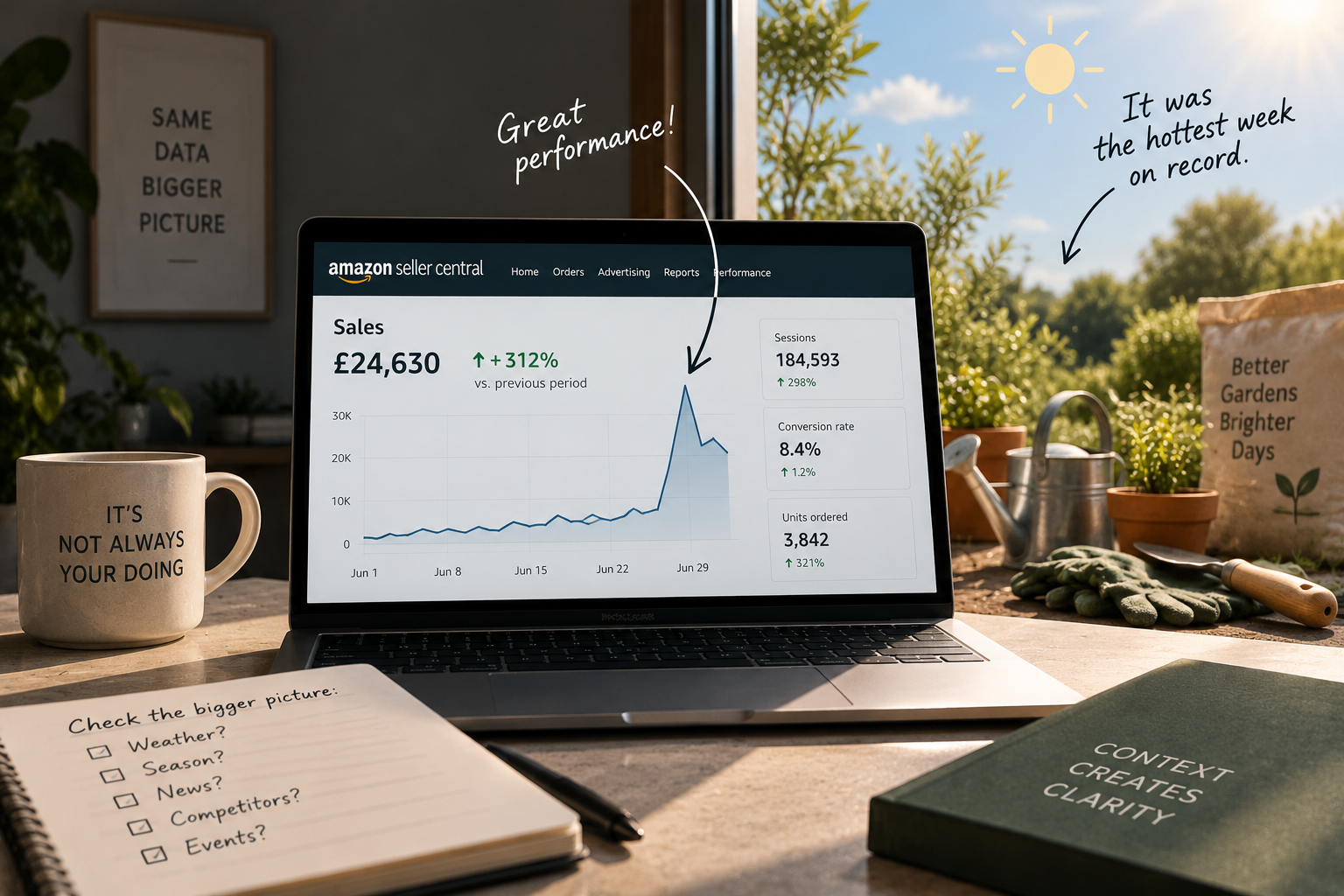
Picture a gardening brand quietly ticking along on Amazon. One week, sales suddenly spike — a really good couple of days, well above the norm. The natural, human, slightly flattering conclusion is: we're doing a great job. The optimisation's working. Let's pour more budget into these campaigns and press the advantage.
Now picture the same person happening to glance at the news and noticing it was the sunniest, hottest week the country had seen in over a century. Suddenly the spike has a very different explanation — and it's got nothing to do with anything they did. That gap, between "our work caused this" and "the weather caused this," is one of the most important and most neglected ideas in reading Amazon data.
Your dashboard has walls
Here's the fundamental limitation: your Amazon dashboard shows you what happened inside Amazon. Impressions, clicks, conversions, spend — all of it bounded by the edges of the platform. What it cannot show you is the enormous world outside Amazon that moves your sales around: the weather, the season, a news story, a viral moment, a competitor's stockout, an economic shift, a change in what people are searching for because of something happening in the actual world.
None of that appears in your funnel analytics. The dashboard doesn't have a column for "it was gloriously sunny." So if you read your sales data as though Amazon were a sealed box where only your actions matter, you will constantly misattribute — crediting your optimisation for a sunshine spike, or blaming your listing for a slump that was really a grey, cold week keeping the gardening crowd indoors.
Why misattribution is so expensive
This isn't a harmless philosophical point — misreading external context for internal cause leads to genuinely costly decisions.
Take the sunshine spike. Read it as "my campaigns are suddenly on fire," and the logical move is to dramatically increase spend on those campaigns to ride the wave. Then the weather breaks, the sky goes grey, and demand returns to normal — but now you've got elevated budgets pouring into campaigns that were never actually the reason for the spike. The ads spend, they don't convert the way they briefly did, and you burn margin chasing a performance that the weather created and the weather took away. You didn't just misunderstand the past; you made a real, expensive future decision on a false reading.
Or worse: you could change your whole strategy based on it. Conclude from a weather-driven fortnight that some new approach is working brilliantly, and rebuild around it — an entire strategy resting on a couple of unusually sunny days. That's a big decision made on an incomplete picture, and incomplete pictures make bad strategists.
The discipline: don't let one number swing your judgment
The lesson isn't "the data is useless" — it's don't allow a single bit of data to swing your judgment without asking what else might explain it. Before you act on a spike or a slump, run the contextual check: is there anything outside Amazon that could account for this? The season? The weather? The news? An event? A competitor's situation? Only once you've ruled out the external explanations should you credit — or blame — your own actions.
That check is pure judgment. No dashboard will ever prompt you with "by the way, it was the hottest April on record" — that connection only ever gets made in a human head that's paying attention to the wider world. Which is exactly why the operators who win aren't the ones staring hardest at the funnel; they're the ones who look up from the funnel and ask what's happening in the actual world that might explain what the numbers are doing.
Turning context into an advantage
And here's the upside, because this cuts both ways. Once you're in the habit of factoring in external context, it stops being just a way to avoid mistakes and becomes an edge. You can anticipate the sunny-week spike and make sure you're well-stocked and well-positioned for it, rather than being surprised by it. You can recognise a seasonal pattern and plan inventory around it. You can spot that a slump is external and hold your nerve — not slashing budgets or panic-rewriting a listing that was never the problem — while your competitors, reading the same slump as an internal failure, thrash around making it worse.
Context awareness turns you from someone the outside world happens to into someone who reads the outside world and positions for it. The dashboard shows you the inside. Your judgment supplies the outside. Put them together and you understand your sales; rely on the dashboard alone and you'll spend your life confidently explaining the weather as if it were your own genius or your own failure.
FAQ
Why can't my Amazon dashboard explain a sudden sales spike?
Because it only tracks what happens inside Amazon: impressions, clicks, conversions, spend. It has no way to show external factors like weather, news, or seasonal shifts that also move demand.
What's the risk of misreading a weather driven spike as a campaign win?
You'll likely pour more budget into campaigns you believe are suddenly working, then lose that spend once the weather changes and demand returns to normal, since the campaigns were never actually the reason for the spike.
How do you avoid misattributing a spike or slump to your own actions?
Before crediting or blaming your own strategy, check whether anything outside Amazon, the season, the weather, the news, or a competitor's situation, could explain the change first.
About the author
Zamir Cajee is co-founder of This Way Up, a UK business specialising in Amazon marketplace strategy, and co-host of The Upside Podcast, where he and the team break down how Amazon actually works — and how it lies to you. Zamir has built multi-million dollar businesses from scratch and has been selling into the EU since 2016.
Ready to take your Amazon Store to the next level? Start by exploring the tools available to create a standout Storefront or make the process even easier by reaching out to us for tailored guidance.
Subscribe to the This Way Up newsletter for impactful strategies and insights, or tune in to The Upside podcast for expert advice on successfully managing your e-commerce efforts.