

VAT is probably the single biggest source of "the EU is too complicated" anxiety, and I understand why: the mental image is 27 countries, each with its own VAT system, each demanding its own registration and returns. If that were the reality, it genuinely would be a nightmare. The good news is it mostly isn't. There are schemes specifically designed to simplify it. The catch is that how you fulfil orders, especially whether you use Pan-EU FBA, changes the picture significantly. Let me map it plainly.
Usual caveat, and it matters doubly for tax: this is orientation, not tax advice, VAT rules and thresholds change, and you should take proper professional advice on your specific situation. VAT is exactly the area where a good accountant pays for themselves.
The simplifying schemes: OSS and IOSS
Start with the reassuring part. The EU built mechanisms specifically to spare you from registering separately in every single country you sell to.
OSS (One-Stop Shop) is, broadly, the scheme that lets you handle VAT on your cross-border sales within the EU through a single registration and return, rather than registering in every destination country. If you're shipping to consumers across multiple EU countries from a base of stock, OSS is the mechanism designed to stop that becoming 27 separate VAT registrations. One registration, one return, covering your distance sales across the bloc — that's the intent.
IOSS (Import One-Stop Shop) is the equivalent simplification for goods being imported into the EU to consumers, for consignments within a certain value. It's designed to streamline the VAT collection on imported low-value goods so it can be handled in one place rather than at each border messily. If you're shipping from outside the EU to EU consumers, IOSS is the mechanism that's meant to make the VAT side manageable.
The point of both: the EU is not actually asking most sellers to register individually in 27 countries. The "27 nightmares" image is outdated — these schemes exist precisely to collapse that into something far simpler. So the first thing to do is drop the assumption that EU VAT means endless separate registrations. For a lot of selling models, it doesn't.
Where it gets more involved: holding stock in a country
Here's the nuance that trips people up. The simplified schemes largely cover selling and shipping across borders. But the moment you hold stock in a country (store your inventory physically there) you generally trigger a VAT registration obligation in that country, because you've got a taxable presence there. Storing goods somewhere is different from shipping to someone there.
This is exactly why fulfilment method drives your VAT position. If you hold stock in one country and ship out from it, your registration picture is relatively contained. But if your stock gets distributed across warehouses in multiple countries — which is precisely what some Amazon fulfilment programmes do — you can find yourself needing VAT registration in each country where your stock is held. The stock's location, not just your sales, drives the obligation.
The Pan-EU question and the reported five-country rule
Which brings us to Pan-European FBA, and a specific, important piece of current information. Pan-EU FBA works by distributing your stock across multiple EU countries so Amazon can fulfil locally and fast. That's great for delivery speed and cost, but because your stock is now physically held in several countries, it triggers VAT-registration obligations in those countries.
And here's the current figure to know: as reported in early 2026, Pan-EU FBA eligibility requires VAT registration in a minimum of five EU countries, up from four previously. That's a material commitment: five VAT registrations, with the ongoing returns and compliance each entails. It's not prohibitive for a business doing the volume to justify it, but it's a real fixed cost and admin load that has to be earned by the sales it enables.
What this means strategically
The practical upshot is that your VAT burden should be a deliberate choice driven by your fulfilment strategy, not an accident you back into. If you use the simplified schemes and hold stock in one place, your VAT life is relatively simple. The moment you opt into distributing stock across countries (Pan-EU being the prime example) you take on multi-country registration (reportedly five for Pan-EU), and that should be a decision you make consciously, when your volume justifies the fixed cost, not a surprise you discover after switching something on.
That's the real headline: don't let a fulfilment setting silently dictate your tax obligations. Understand that holding stock in a country means VAT there, that the simplified schemes handle a lot of the cross-border selling, and that Pan-EU's speed comes bundled with a multi-country VAT commitment. Choose your fulfilment model with the VAT consequences in full view, ideally with an accountant who knows EU VAT, and it's a manageable, deliberate cost rather than a nasty surprise.
General orientation, not tax advice: VAT rules and the Pan-EU country requirement change; confirm current rules and take professional advice before acting.
FAQ
Do I need to register for VAT in every EU country I sell to?
No. OSS (One-Stop Shop) lets you handle VAT on cross-border sales within the EU through a single registration, and IOSS does the same for goods imported into the EU. Most sellers who don't hold stock in multiple countries can use these instead of registering separately everywhere.
When do I need to register for VAT in a specific EU country?
When you hold stock there. Storing inventory in a country generally creates a taxable presence and triggers a local VAT registration obligation, regardless of the simplified schemes.\
How many countries require VAT registration for Pan-EU FBA?
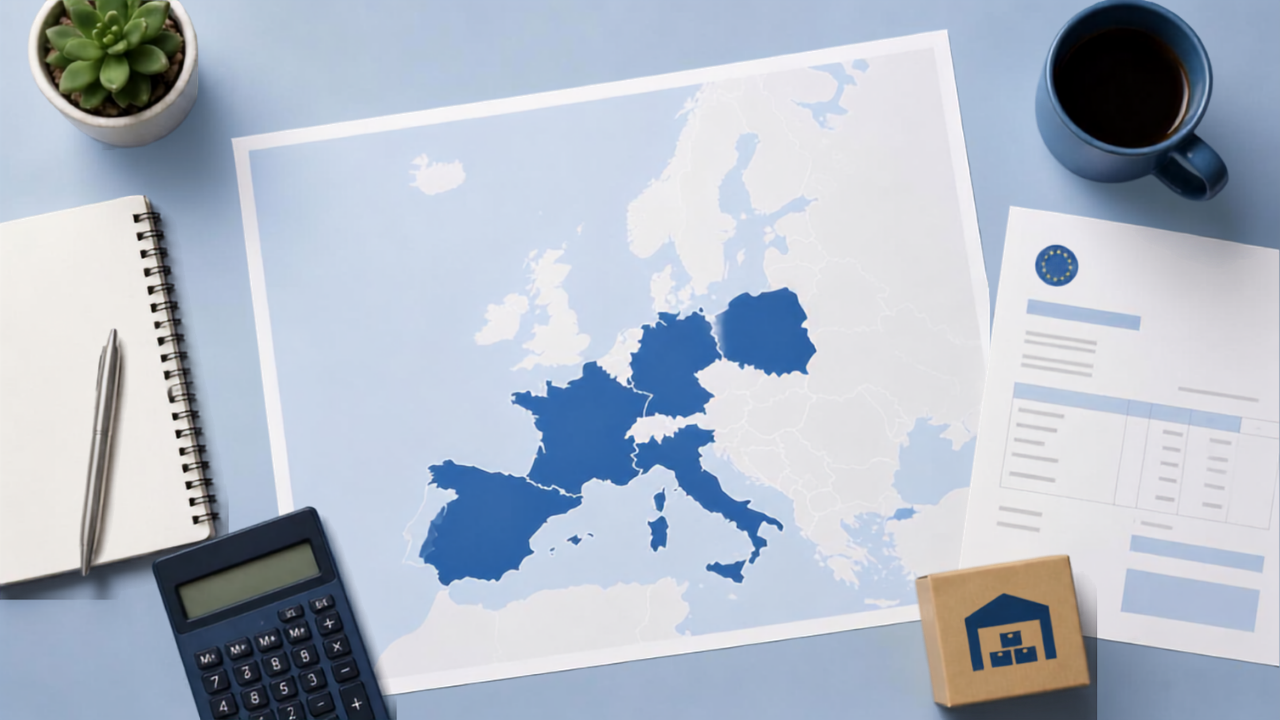
As of 2026, Pan-EU FBA requires VAT registration in a minimum of five EU countries: Germany, France, Poland, Italy and Spain (Spain was added this year, up from four previously).
About the author
Zamir Cajee is co-founder of This Way Up, a UK business specialising in Amazon marketplace strategy, and co-host of The Upside Podcast, where he and the team break down how Amazon actually works — and how it lies to you. Zamir has built multi-million dollar businesses from scratch and has been selling into the EU since 2016.
Ready to take your Amazon Store to the next level? Start by exploring the tools available to create a standout Storefront or make the process even easier by reaching out to us for tailored guidance.
Subscribe to the This Way Up newsletter for impactful strategies and insights, or tune in to The Upside podcast for expert advice on successfully managing your e-commerce efforts.