

When a UK seller finally decides to try the EU, the default instinct is to reach for Pan-European FBA — it's the flagship programme, it promises fast local delivery everywhere, it sounds like the way to do Europe properly. And for an established, high-volume EU business, it often is. But as a first move, it's usually the wrong one, because it commits you to a heavy fixed cost before you've proven there's any demand to justify it. There's a cheaper, smarter way to dip your toe in: EFN.
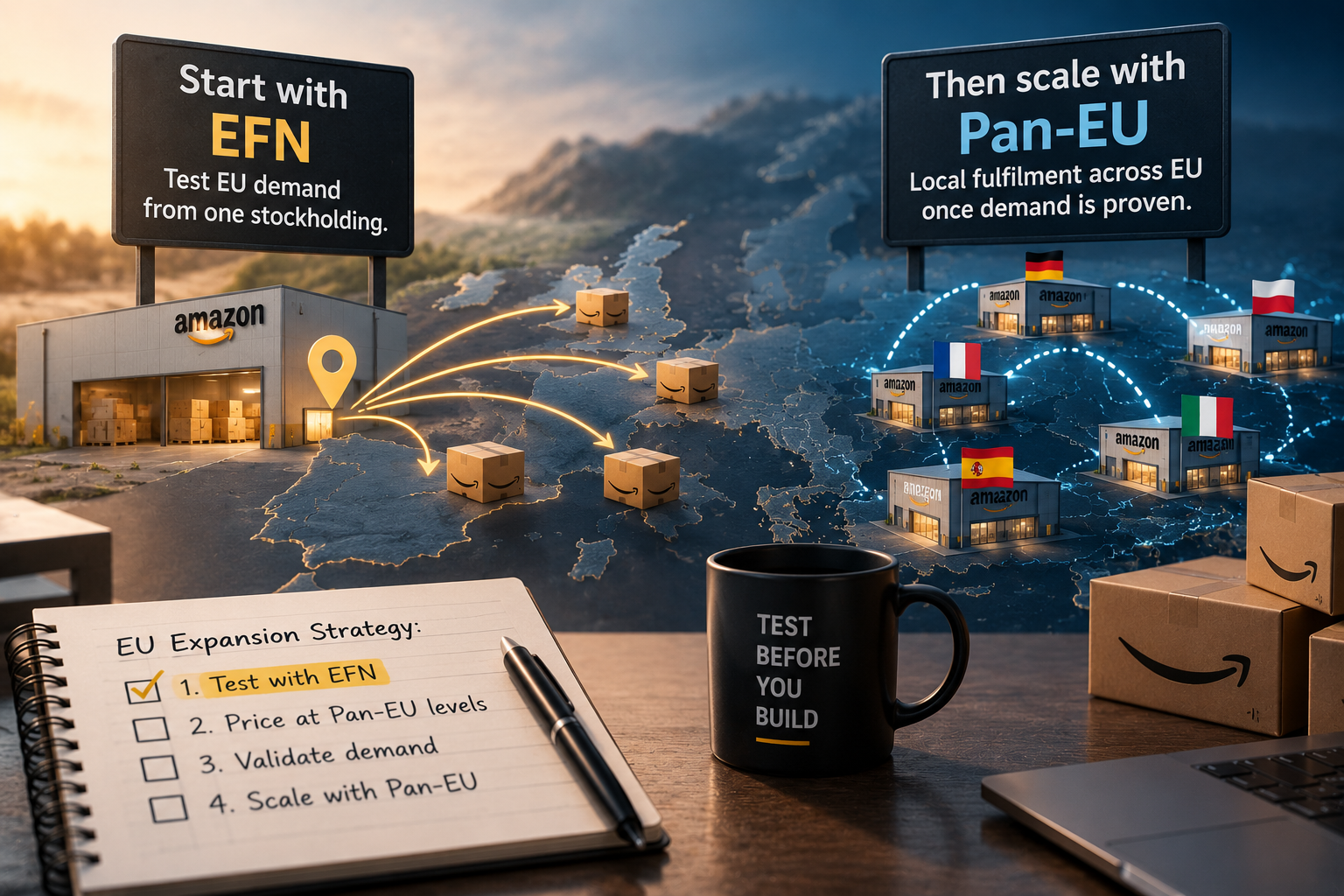
Let me lay out the sequence I'd actually recommend for testing EU demand without betting the farm.
The problem with leading with Pan-EU
Pan-EU FBA distributes your stock across multiple EU countries so Amazon fulfils locally. Fast delivery, lower fulfilment cost per order — genuinely good things. But that distributed stock triggers VAT-registration obligations in every country it's held in — reportedly a minimum of five EU countries as of early 2026. So switching on Pan-EU means committing, upfront, to five VAT registrations and their ongoing returns and compliance.
Think about the order of operations that implies. Leading with Pan-EU means you take on that whole fixed cost before you know whether Europe will buy your product at all. You're paying the price of full-scale infrastructure to run an experiment. If the demand's there, fine — but if it isn't, you've saddled yourself with five countries of VAT admin for a market that didn't pan out. That's backwards. You don't build the factory before you've confirmed anyone wants the product.
The EFN alternative: test cheaply from one base
EFN — the European Fulfilment Network — works differently, and it's ideal for a first foray. In essence, it lets you hold your stock in one country and fulfil orders to customers in other EU marketplaces from that single stockholding. You're not distributing inventory across five countries; you're keeping it in one place and letting Amazon ship it across borders to EU customers.
The consequence that matters: because your stock sits in one country, your VAT-registration footprint is far lighter than Pan-EU's multi-country requirement. You can start selling into the EU from a single base, with a fraction of the registration burden, and see whether the demand is actually there — before you commit to the heavy infrastructure. It's the minimum viable version of EU expansion: cheap enough to be an experiment, real enough to give you genuine data.
Yes, EFN fulfilment costs more per order than local Pan-EU fulfilment, and delivery can be a bit slower since it's crossing borders from your single base. That's the trade-off. But for testing, that per-order premium is vastly cheaper than the fixed cost of five VAT registrations for a market you haven't validated. You're paying a bit more per sale to avoid a large upfront commitment — exactly the right trade when you're still finding out if the demand exists.
The pricing trick: price as if you were on Pan-EU
Here's a refinement that makes the EFN-first approach genuinely clever rather than just cautious. When you test on EFN, price your product as if you were already on Pan-EU — at the price you'd need to charge once you're fulfilling locally and cheaply — even though EFN is costing you more per order right now.
Why? Because it gives you a clean read on real demand at your real target price. If you priced to cover EFN's higher per-order cost, you'd be testing at an inflated price that you'd never actually charge at scale — and weak sales might just reflect the inflated price, not weak demand. By pricing at your eventual Pan-EU level, you find out whether the market wants your product at the price you'd genuinely sell it for. You accept a thin margin (or even a small loss) per unit during the test, in exchange for accurate demand data at the price that matters. You're buying information, and pricing it correctly is what makes the information trustworthy.
So the test is: EFN fulfilment (cheap to set up, light on VAT), priced at Pan-EU levels (accurate demand signal), accepting thin margin during the experiment (the cost of buying clean data). If the demand shows up at that price, you've validated the market and then it makes sense to invest in Pan-EU's infrastructure to serve it profitably. If it doesn't, you've learned that cheaply, without five countries of VAT admin to unwind.
The sequence, in short
Here's the whole strategy in order. Test EU demand on EFN first, from a single stockholding, with a light VAT footprint. Price as if you were on Pan-EU, so your demand data reflects your real target price. Accept thin margin during the test as the price of clean information. Then, only once the demand is proven, graduate to Pan-EU and its multi-country VAT commitment to fulfil that proven demand fast and cheaply at scale.
It's the difference between running an experiment and making a bet. Leading with Pan-EU is betting on Europe before you have evidence. Leading with EFN is testing Europe cheaply and letting the evidence tell you whether to make the bigger commitment. For anyone dipping into the EU for the first time, test before you build — EFN is how you test, and Pan-EU is what you graduate to once the test comes back positive.
*General orientation, not legal or tax advice — programme rules and VAT requirements change; confirm current details and take professional advice before acting.
FAQ
What's the difference between EFN and Pan-EU FBA?
EFN (European Fulfilment Network) lets you hold stock in one country and fulfil EU orders from that single stockholding, while Pan-EU FBA distributes stock across multiple EU countries for faster, cheaper local fulfilment, at the cost of a much heavier VAT registration footprint.
Why start with EFN instead of Pan-EU when entering the EU?
Because Pan-EU requires VAT registration in a minimum of five EU countries (as of 2026), a large fixed cost to take on before you know whether there's real demand. EFN lets you test that demand from a single VAT registration first.
How do you get an accurate demand signal when testing on EFN?
Price your product as if you were already fulfilling on Pan-EU, at your real target price, even though EFN costs more per order. That way weak sales reflect genuine demand rather than an inflated test price.
About the author
Zamir Cajee is co-founder of This Way Up, a UK business specialising in Amazon marketplace strategy, and co-host of The Upside Podcast, where he and the team break down how Amazon actually works and how it lies to you. Zamir has built multi-million dollar businesses from scratch and has been selling into the EU since 2016.
Trying to work out whether to test the EU on EFN or go straight to Pan-EU? Reach out to us for tailored guidance.
Subscribe to the This Way Up newsletter for impactful strategies and insights, or tune in to The Upside podcast for expert advice on successfully managing your e-commerce efforts.